
Branding Through Color: The Real Magic of Christmas
By Danicka Joseph
As the holiday season rolls on, we roll out the gatherings with loved ones that raise our spirits— sometimes, our blood pressure— and leave us with warm memories painted in festive colors.
Although they may just seem like yet another component of holiday decor, colors play a larger role than many of us realize. They serve as a visual means of communicating the sentiment of the occasion. For example, which holiday comes to mind when asked to picture the colors red and pink? What about black, purple, and orange? Red, green, and gold? Chances are that you thought of Valentine’s Day, Halloween, and then Christmas. But why? Were we all secretly hypnotized into forming these associations?
Sort of…but not exactly.
Let’s Talk Branding.
Colors are arguably the most crucial part of branding. Branding is a shortcut—an easy way to quickly clue people in to certain pieces of information. It’s how black, purple, and orange convey the spookiness of Halloween, and pink and red, the romantic mood of Valentine’s Day. Likewise, brands rely on color to help people quickly recognize the products and organizations they trust. It’s how you’re able to buy your favorite box of cereal without perusing the aisle for an hour, reading the name on each individual box.
Dr. Satyendra Singh, a professor of marketing and international business at the University of Winnipeg (Canada), found that people form impressions about a brand with 90 seconds of initial interaction, 62 to 90% of which is based solely on color. The relationship between color and brand is so strong that color forms part of a brand’s identity. One example of this can be seen in how light medium robin egg blue is now dubbed Tiffany blue, after the luxury jewelry company whose brand it represents.
One brand in particular has even gone so far as to assume cultural ownership of both a color and a holiday. Want to take a guess?
Red: The Color of Joy, Christmas, and Coca-Cola
The Coca-Cola brand thrives at the intersection of color and the holidays. The reason Coca-Cola has become so successful during the holiday season is the company’s strong understanding of its audience and its brand identity.
For many people, the popular fountain drink is synonymous with the color red and/or Christmas. The Vice President of Global Design, James Somerville, has even called Coca-Cola red the company’s second secret ingredient. Another large part of the company’s brand identity is its promise to spread joy. From the more modern ads in which people “Share a Coke” with friends to the very simple first ads depicting smiling characters, Coca-Cola has consistently enforced the idea that someone with a bottle of Coke in hand is bound to be happy.
It is not difficult to see how a company that positions itself as a source of joy, and boasts the color red, is able to easily associate itself with the joyful holiday whose primary color is also red. Red also happens to be a color that signals urgency and can trigger impulse buying. This joyful sense of urgency is perhaps the reason why, from a business sense, Coca-Cola performs so well during the holiday season. In 2021, for example, Coca-Cola trademark sales increased by 36% over the Christmas period.
The relationship between Christmas and Coca-Cola extends beyond their shared use of red and their mission to spread joy. In fact, the image of Santa we have today is largely due to Coca-Cola’s influence.
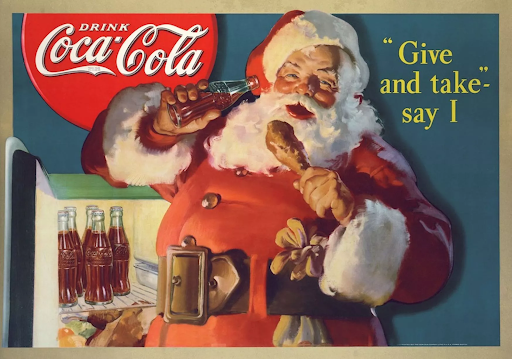
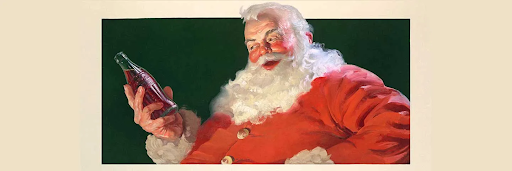
Civil War cartoonist Thomas Nast first changed the color of Santa’s coat from tan to a vibrant red. In the 1920s, Coca-Cola began employing depictions of Santa and its Christmas advertising, and in the 1930s, artist Fred Mizen painted Santa drinking a bottle of Coke. It wasn’t until 1931, however, that Coca-Cola commissioned Haddon Sundblom to create a wholesome Santa who was unlike his previously stern depictions.
As time progressed, the warm and friendly face of this plump and now human version of Santa became more than just a character in an advertisement. Depictions of him delivering presents, reading letters, greeting children, raiding refrigerators, and drinking Coke became such a widely cherished symbol of Christmas that The Coca-Cola Company received letters whenever people noticed a small change in the images. These beloved Santa depictions have also found themselves exhibited at various museums and department stores around the world.
The Future of Coca-Cola Christmas Advertising
By utilizing the power of branding, Coca-Cola has built up a big reputation through its advertising, particularly when it comes to Christmas advertising. Now only one question remains: How will the company continue to carry this legacy while adapting to our ever-changing world?
Recent Christmas ads suggest that the answer begins with an “A” and ends in “I.”

For the second year in a row, Coca-Cola released a Christmas ad powered by artificial intelligence (AI). Unlike the 2024 ad, the 2025 remake of the “Holidays Are Coming” campaign does not feature humans— a decision likely taken after the backlash regarding the previous year’s uncanny depictions of AI-generated humans. Unfortunately, this tweak was not enough to prevent a fresh wave of disgruntled complaints.
Still, Coca-Cola’s Global Vice President and Head of Generative AI, Pratik Thakar, defends the company’s decision to continue with AI advertising, explaining the fact that it “worked for [their] business” is “what motivated [them] to keep going.” Despite the backlash the 2024 ad received, it still secured a position as the world’s top-performing Christmas ad across all categories that year. Perhaps the same will happen with this year’s ad.
In a world where AI continues to advance exponentially, and society seems to be split on whether this advancement is doing more good or harm, one has to wonder: Is it worth it? Is Coca-Cola securing its spot at the forefront of advertising and technological innovation? Or will the company be among the first to fall?
Time will tell.
What is certain is that the decision to pursue such a make-or-break idea for the annual holiday campaign is a testament to the amount of power that exists behind Coca-Cola’s Christmas “cred.” In the words of Thakar himself, “The global Christmas campaign is our year’s biggest business opportunity.”
And to think, it’s all thanks to color.